
Metallic epoxy in Santa Clarita.
A poured metallic floor is a chemical reaction you get one attempt at. In this valley the heat decides how long that attempt lasts.
Why Santa Clarita asks for this one by name.
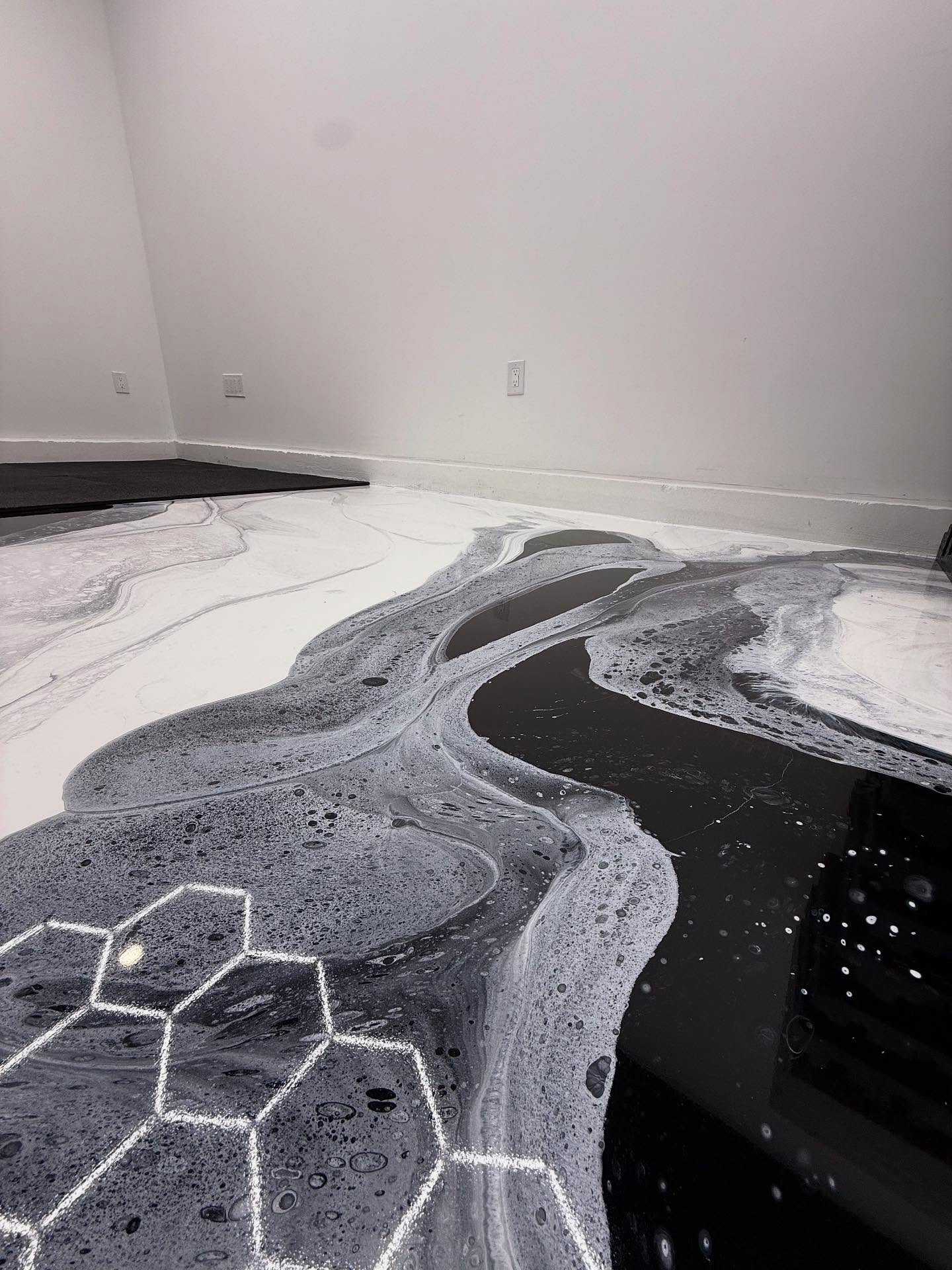
Metallic is the system Santa Clarita requests more than any other, and the housing stock explains it. Large newer garages with good natural light are exactly where a poured metallic floor reads well, and the master-planned tracts here are full of them.
The rest is commercial: showroom and lobby floors through the Valencia business parks, and the occasional Newhall interior where a homeowner replaces tile with a poured floor entirely. Those are different jobs from a garage, mostly because a lobby cannot close for three days and a garage can.
What nobody can promise, including us, is a specific pattern from a photograph. Metallic pigment migrates as the resin moves and settles, so the veining is a record of that movement frozen when the resin gels. We can match a palette, a contrast level and a general character. The exact figure is decided in the room on the day.
What decides whether a metallic pour succeeds.
Valley heat
Resin cures on temperature. An unconditioned Santa Clarita garage in July gives minutes of working time rather than the window the datasheet promises, so these get scheduled early or cooled.
Slab flatness
Metallic is self-leveling and thin. Every trowel mark, low spot and old adhesive ridge telegraphs through, so grinding is most of the job rather than a preliminary.
Moisture
A metallic pour over an untested slab blisters, and a blister cannot be repaired invisibly because the pattern cannot be matched. Reading the slab is not optional on this system.
The crew
The pattern comes from how two people move the resin in the first fifteen minutes. That is technique, not product, and it is the one part of this trade where the crew genuinely decides the outcome.
The trade-off nobody mentions until it matters.
Metallic cannot be spot-repaired. A gouge cannot be blended in, because the surrounding pattern is unrepeatable by anyone including the person who poured it. The options are re-pouring that section and accepting a visible boundary, or re-pouring the room. Anybody telling you a metallic floor can be touched up has not had to do it.
That is worth knowing before you buy rather than after. For a showpiece garage or a lobby where damage is unlikely, it is the right system and it looks like nothing else. For a workshop floor that takes dropped tools, or a commercial back-of-house area, we will steer you toward flake instead, which repairs almost invisibly because its pattern is random.
The build is grind, patch, prime, pour, then two clear topcoats. The topcoats are what you actually walk on and what takes the abrasion, so gloss level and scratch resistance are decided there rather than in the metallic layer. Any floor getting direct sun through a window or a garage door light needs a UV-stable topcoat, because standard clear ambers noticeably and it shows badly on a light pour.
Three to four working days for a normal room, with cure time between coats, and light foot traffic usually the day after the final topcoat. Vehicles after about a week on a garage. The dry climate here helps those numbers land closer to the datasheet than they would nearer the coast.
If the room takes real abuse, flake is the better call instead. For a commercial space wanting the slab itself as the finish, polished concrete is a different direction entirely, and back-of-house is usually commercial epoxy. The full pour process is written up on the main metallic epoxy page. We pour across Santa Clarita and Los Angeles County.
Questions before the call.
Can you match a floor I saw online?
We can match the palette and the general character, not the pattern. The veining comes from how the resin moves in the first fifteen minutes and it is genuinely unrepeatable, including by whoever poured the original. Anyone promising an exact match is either misunderstanding the product or telling you what you want to hear.
What happens if it gets damaged?
This is the real trade-off. A gouge cannot be blended because the surrounding pattern cannot be recreated, so the options are re-pouring that section with a visible edge, or re-pouring the room. If the space is likely to take damage we will recommend flake instead and explain why rather than selling you the more expensive system.
Does the summer heat here ruin a metallic pour?
It compresses the working window rather than ruining anything, provided the crew plans for it. A slab sitting hot makes the resin gel considerably faster, so we schedule these for early morning or bring cooling into the space. A crew that turns up at noon in August and opens the resin anyway is how a metallic floor goes wrong.
Will it yellow in the sun?
Standard epoxy ambers under UV and it is very visible on a light metallic. Any floor of ours getting direct sun gets a UV-stable polyurethane topcoat. If somebody quotes a metallic floor for a sunlit room without mentioning UV, that is a real gap in the quote rather than a detail.
Is it slippery?
A gloss metallic with no additive is slick when wet. In a garage where a car comes in during rain, or anywhere near a pool, we add a fine texture to the topcoat, which costs a little clarity in the reflection and makes the floor safe. In a dry showroom or a lobby we usually leave it smooth.
Can you pour over tile?
Not directly. Tile has to come up or be ground back to a sound level substrate, because any movement or hollow underneath telegraphs through a thin metallic layer within months. Removal is dust and disruption and it is the honest route rather than pouring over a floor that is going to crack along every grout line.
Santa Clarita, California. Valencia, Saugus, Newhall, Canyon Country and Stevenson Ranch.
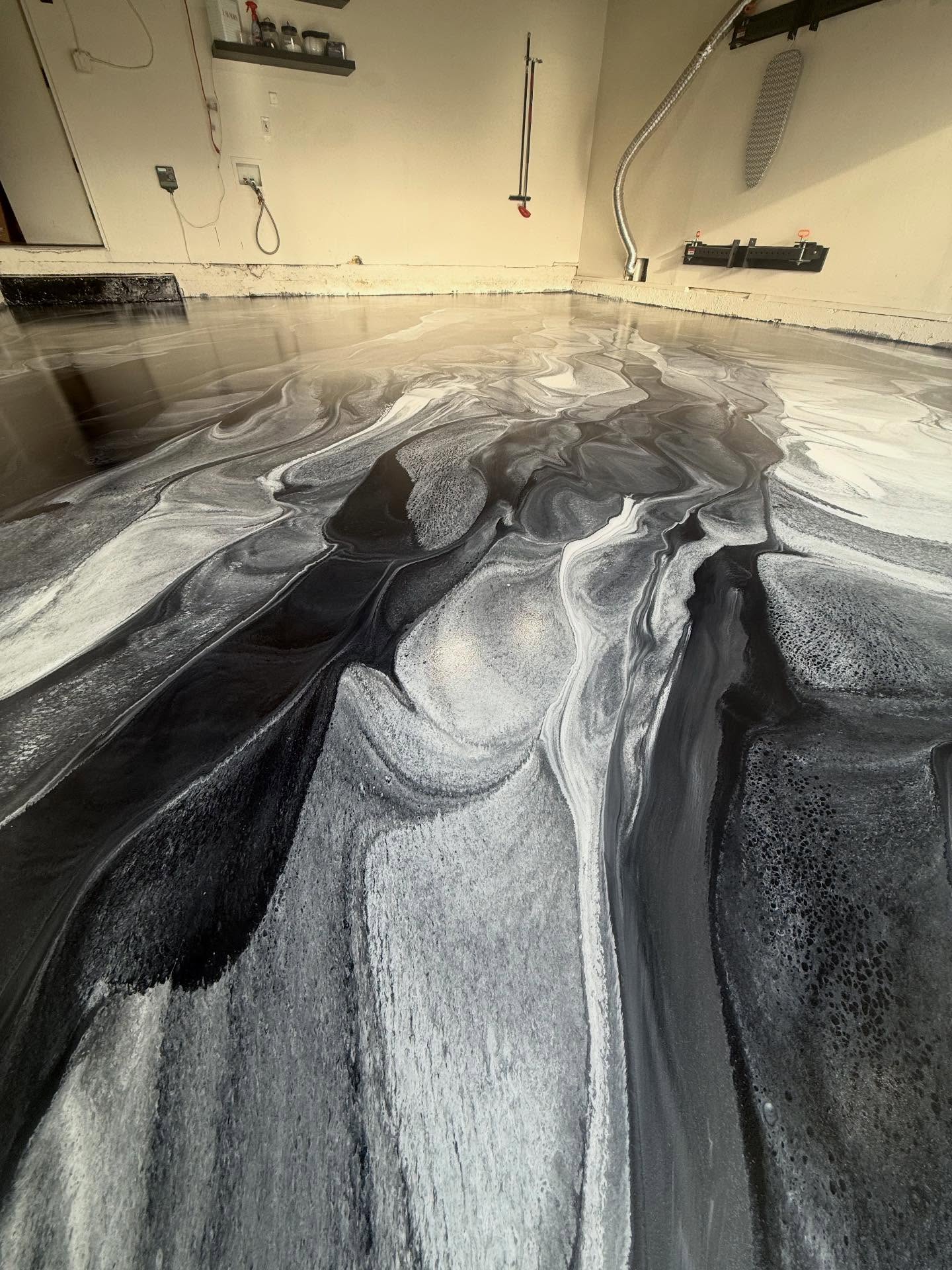
Metallic epoxy for your Santa Clarita floor.
Free walkthrough in 30 minutes, fixed-price proposal the next morning. Tell us the room, the square footage and what happens on the floor.