Commercial epoxy in Glendale.
Glendale’s commercial floors sit behind storefronts on Brand Boulevard, under restaurant kitchens and inside light industrial shops around the city. Most of them have to stay in business while we work. We plan the floor around the hours you can give us first, then pick a system that fits inside them.
Who calls us for a Glendale commercial floor.
Brand Boulevard is Glendale’s main commercial street, and much of what we coat along it is the part customers never walk into: the stockroom behind a shop, the corridor out to the loading door, the back half of a suite. Those floors take carts, pallet jacks, dropped cartons and mop water every day, and bare or painted concrete does not hold up long under that.
Restaurant kitchens are their own problem. The floor is wet, greasy and warm for most of a shift, people move fast on it, and it gets scrubbed hard every night. That is where we lean on a quartz broadcast, which builds grit into the coating so a wet floor still gives a shoe something to hold.
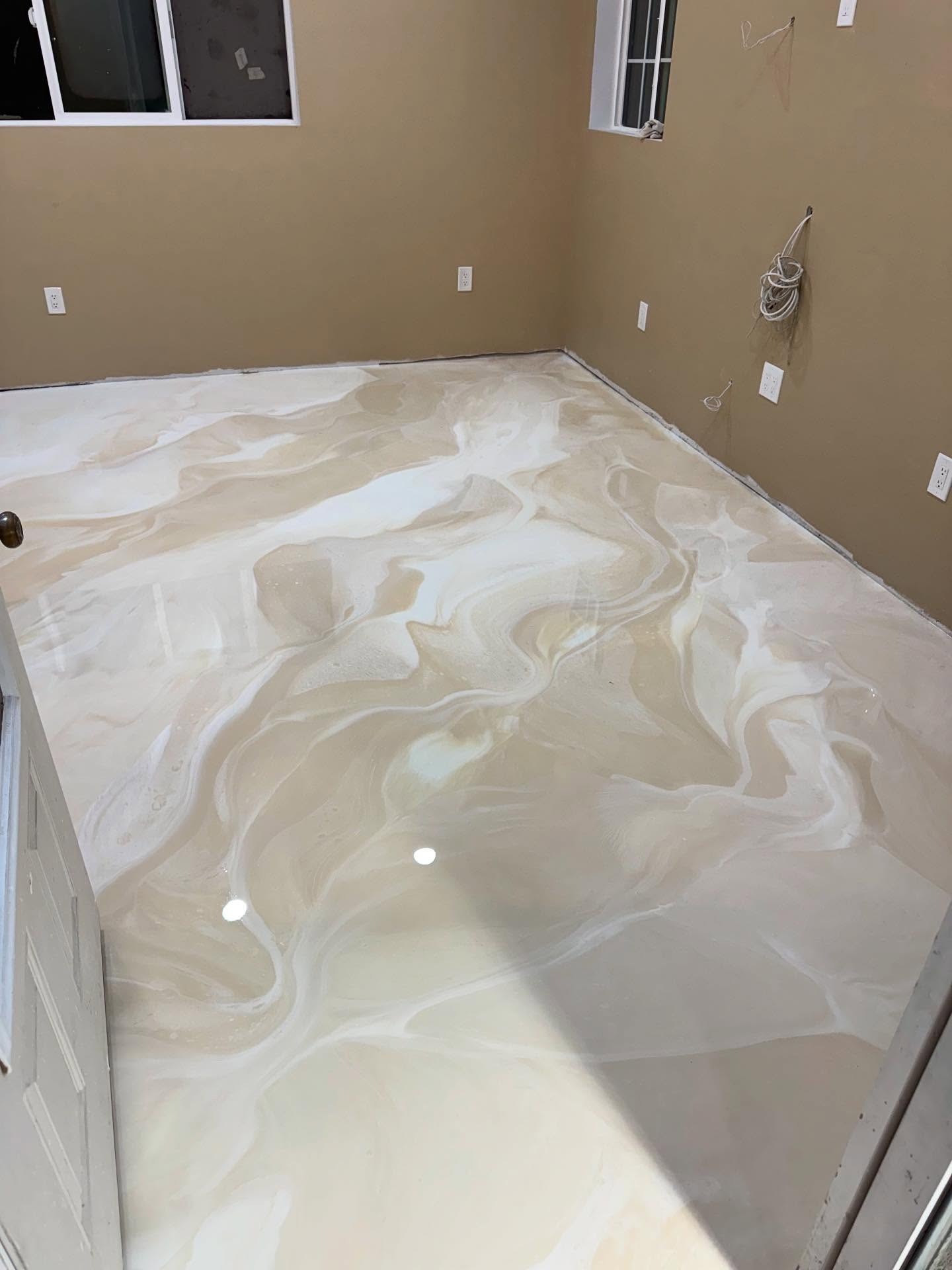
Light industrial shops and office suites between tenants round out the list. The room at the top of this page is what an empty room looks like when we are done: a cream and white metallic floor, finished before anyone moved back in. An empty space is the simplest commercial job we get, since nobody is working around us. Most commercial work is not empty, and the rest of this page is about how we handle a space that is still open for business.
Choosing a system for the room you have.
Polyaspartic for a short window
When a business can give us a night or a weekend and nothing more, polyaspartic is usually the answer. It cures much faster than a standard epoxy, so the room goes back into use on the day you planned rather than days later.
Quartz where it gets wet
Dish stations, mop sink corridors, walk-in thresholds: anywhere water sits on the floor, a quartz broadcast adds texture to the coating. We settle how coarse it should be with you before the pour, since a busy kitchen and a dry backroom want different answers.
A moisture reading first
Slab-on-grade concrete can carry water up from the ground beneath it, and a coating over a damp slab lets go. We meter the slab before any system goes on the proposal, so the spec is chosen for the concrete you actually have.
Cracks and joints on a big slab
A commercial slab has control joints and keeps moving along them. Coat straight over one and a line tends to show up in the finish later. We sort out which cracks are settled and which joints stay open before the system goes down.
Planning the shutdown with your property manager.
Before we set a date, we need three answers from whoever runs the space: when we can get in, how long the room can stay closed, and when it has to be open again. The rest follows from those. A restaurant that is dark one day a week gives us a different job than a retail backroom that can close for a weekend, and both differ from a suite with nobody in it.
Access comes next. Tell us where we can park, how material gets in, whether there is a back or loading door, and who holds the keys after hours. If a property manager has to sign off, or wants to warn neighboring tenants about grinder noise, have that conversation in the week before the pour so nobody is surprised on the night.
Closing the space means clearing the floor. Shelving, racks, prep tables and anything bolted down either moves out or gets worked around, and we tell you which at the walkthrough. Reopening runs on two numbers: people can walk on the floor 24 hours after the last coat, and anything heavy on wheels waits until 72 hours. We plan the return of carts, pallet jacks and equipment around both.
Prep is no different from any other floor we pour. The slab is ground with a dust extractor running, old coatings and cracks get dealt with, and the dust is cleared before resin goes down. Our epoxy floor prep in Glendale page walks through that step in detail.
Some businesses need more than one system under one roof. Detail-shop bays fall under our automotive floor coatings, a finished room facing customers can take metallic epoxy, and owners sometimes ask about garage epoxy for home at the same walkthrough. The main commercial epoxy page carries the general system detail, and the Glendale page lists everything else we pour in town.
Before a Glendale business books a floor.
Will we have to close while the floor goes in?
Often not for long. We schedule around your operating hours, and a polyaspartic system lets a room go back into use far sooner than a standard epoxy. The walkthrough tells us how much floor there is and how long you can give us, and the schedule gets written from those two answers.
Which system works in a restaurant kitchen?
Kitchens usually get a quartz broadcast. The quartz builds texture into the coating so a wet or greasy floor keeps some grip under work shoes, and it stands up to the hard scrubbing a kitchen floor takes every night. We agree on how coarse the texture should be before the pour, not after.
Can the sales floor look different from the back of house?
Yes. Back of house usually gets the tougher, textured system. A sales floor or lobby that customers see can take a metallic finish instead. Both can go on one proposal and one schedule, phased so each area is finished in the order your business needs it back.
When can staff and equipment go back on the floor?
People can walk on it 24 hours after the last coat goes down. Carts, pallet jacks, vehicles and other heavy equipment wait until 72 hours. Both times go on the written schedule, so whoever is planning the reopening knows when each part of the space can be used again.
We lease our space. What does the property manager need from us?
Usually the dates, the hours we will be on site and how we get in after closing. Some buildings also want to warn neighboring tenants about grinder noise or set rules about parking and where we stage material. Bring the manager to the walkthrough if you can. It saves a round of phone calls later.
How do we keep a commercial floor looking good?
A damp mop handles the daily cleaning. The base resin stays bonded to the slab for the life of the floor. The topcoat is the layer that takes the traffic, so that is the part we come back and refresh down the road once the gloss fades. There is no waxing and no stripping.
Glendale, California. Brand Boulevard runs through the middle of town, and our crews arrive by CA-2, I-5 or CA-134.
Put your Glendale shutdown on the calendar.
A free walkthrough takes about 30 minutes. Bring the square footage if you have it, your opening hours and the date you need the room back. A fixed-price proposal lands in your inbox the next morning, written around that window.
See finished floors in the gallery, or send us your hours and the size of the room.