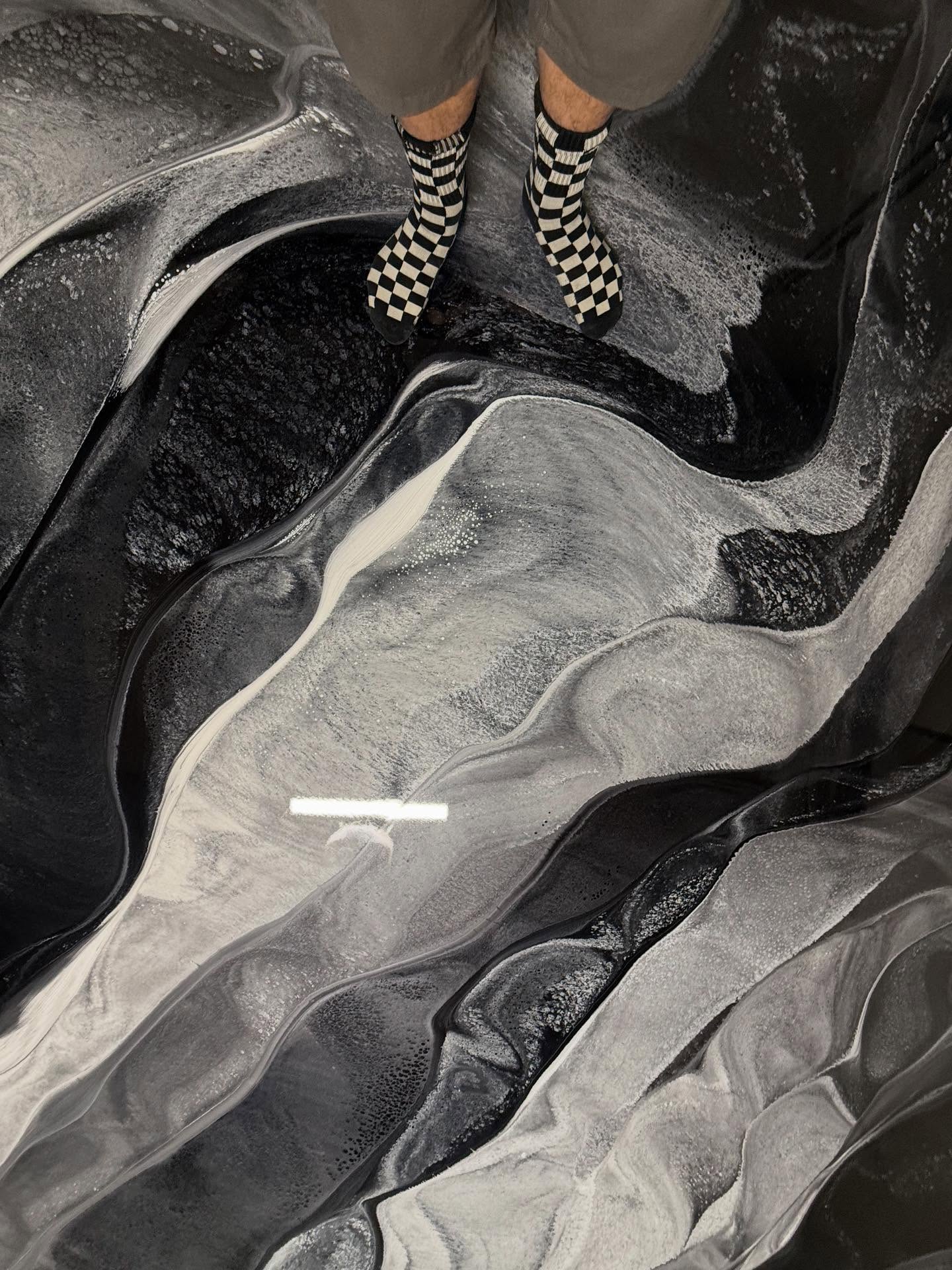
Pasadena floors
Full-broadcast flake, built for Pasadena’s older slabs.
Chips get thrown into wet resin until the surface disappears under color, scraped flat the next morning, then locked down with a polyaspartic topcoat. On a hand-poured 1930s garage slab, that chip layer does something a mirror finish cannot: it absorbs the history of the concrete instead of showing it off.
What the chip layer is actually doing under your feet.
Pasadena garages were troweled by hand, patched by three owners, and never poured over a vapor barrier. Full broadcast is the finish that stops caring about any of that.

Detached garages, thin slabs
A detached garage behind a Craftsman usually sits on three or four inches of hand-finished concrete with trowel swirl still readable across it. Add a patched oil pit, a saw cut for a drain line, and forty years of tire scuff. A metallic pour turns all of that into topography you can see from the doorway. A saturated chip broadcast reads as one texture, so the eye stops hunting for flaws.

The rooms past the garage
Pasadena houses rarely have basements, so the work moves sideways: laundry rooms, mudrooms off the driveway, pool houses, covered patios that catch the afternoon. Those are wet-foot rooms. The chip itself creates the tooth, so we tune the last coat instead of dumping grit into it. Satin with a fine aggregate indoors, a coarser hand outside where the surface stays damp longer.
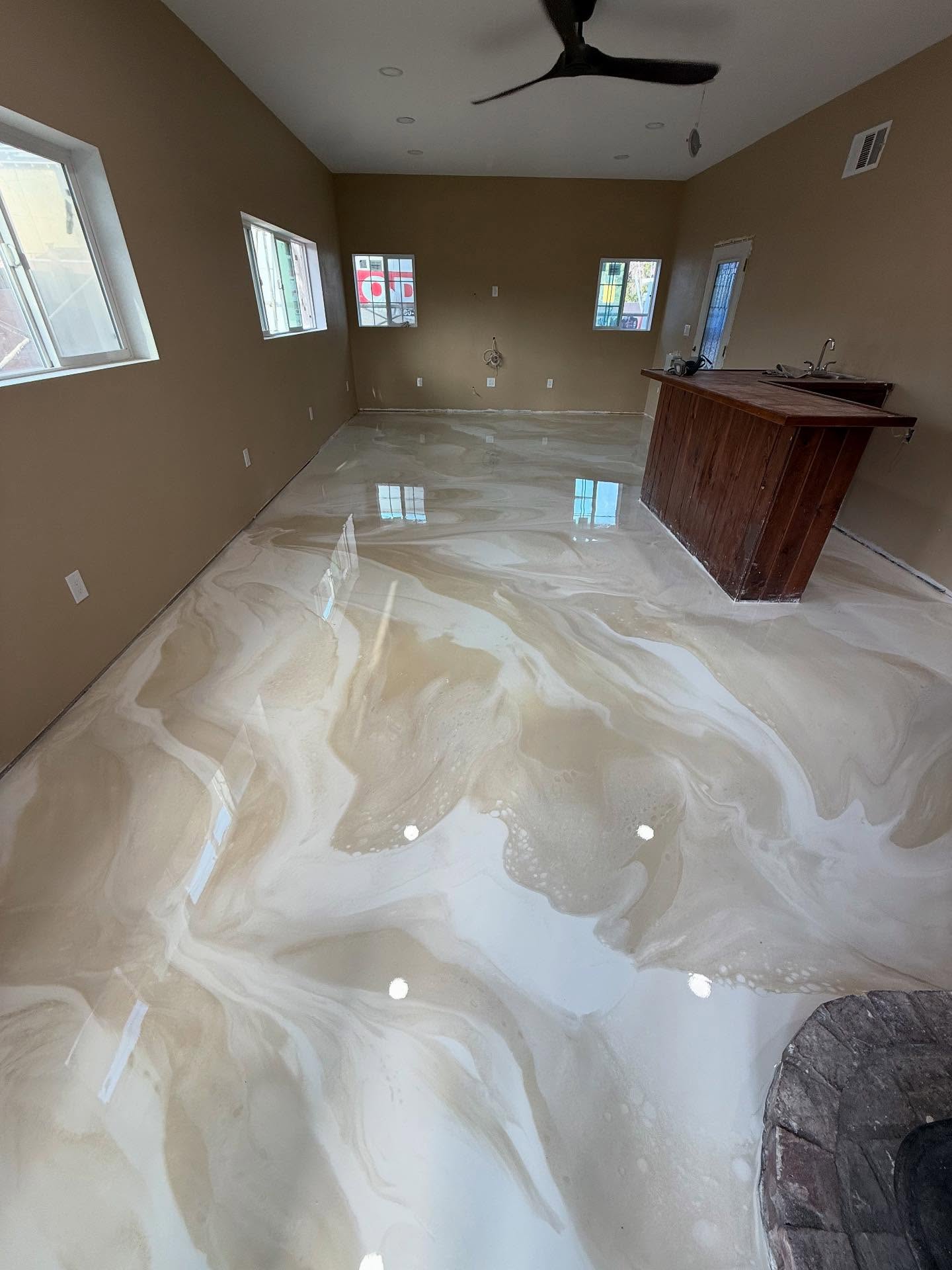
Sun through an open bay
Plenty of people against the foothills leave the bay door open from noon until dark all summer. That is direct inland sun on the same few feet of floor every day, and standard epoxy ambers under it. We finish flake floors with an aliphatic polyaspartic that holds its color, and the pigment lives in the chip rather than in a tinted base coat that would show the shift first.
Blend, chip size, and the house it has to live in.
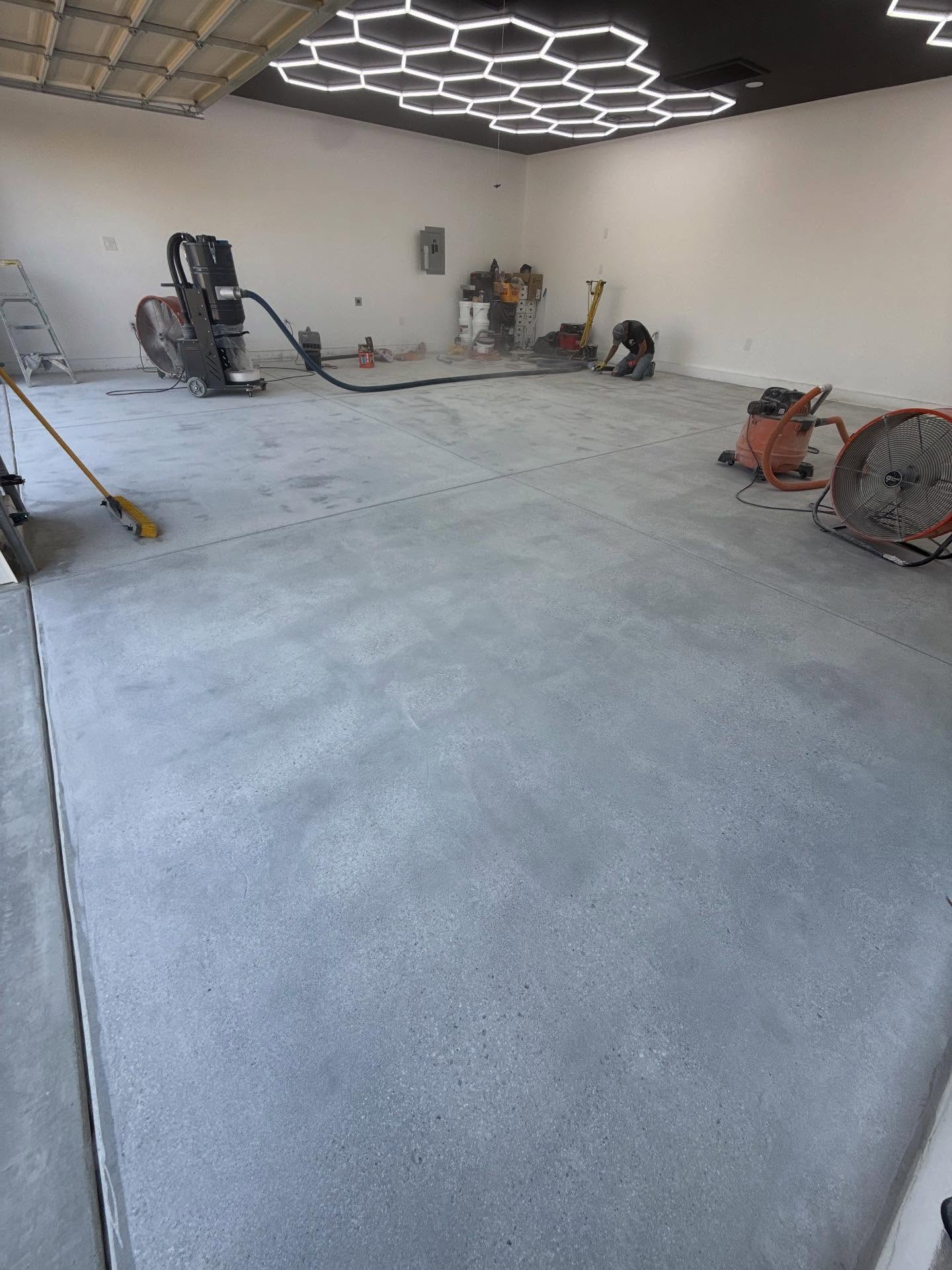
Two things decide whether a chip floor looks like it belongs in a 1926 house or looks like it was ordered from a catalog: the color family, and how big the chips are.
Reading the slab before anything gets mixed
Prep starts with diamond grinding, not an acid wash. On a Pasadena slab we are usually cutting through a sealer somebody rolled on in the eighties, then through the closed cream layer underneath. Old hand-poured concrete grinds unevenly, and that is fine here, because the broadcast buries the profile anyway.
Moisture is the part people skip. These slabs went straight onto dirt with no plastic under them, so groundwater moves up through the concrete whenever the San Gabriels drain in winter. We run relative humidity probes into the slab and let them sit before committing to a system, and a high reading means a moisture-tolerant primer goes first. Skipping that step is how a coating lets go in sheets two winters later.
Choosing a color that agrees with the house
Warm houses want warm chips. Behind a Craftsman with fir trim and a clinker brick chimney, a blend running tan, umber, and a little rust sits down next to the woodwork instead of fighting it. Spanish Colonial works the same way: terracotta tile and saltillo want ochre and earth tones, and a cold gray blend looks borrowed. The mid-century places toward the Arroyo and Linda Vista go the other direction, where cool gray with black and a thread of white reads correctly against steel sash.
Chip size changes the volume more than color does. Quarter-inch chips read fine-grained and quiet from standing height, which is the safe answer for a laundry room or anywhere the floor should not be the loudest thing present. Half-inch chips read as a deliberate pattern with visible individual flakes, great in a big garage and busy in a small mudroom. We set samples on your actual slab in your actual light before you pick, because blends photograph differently than they live.
A floor you can fix in one spot
This is the practical argument, and it usually lands last. If a jack stand punches through a flake floor, we grind the damaged area, re-broadcast the same blend into fresh resin, and re-coat. Because the surface is a field of thousands of chips, the repair disappears into the pattern. A metallic pour cannot do that. Its look comes from a swirl created once, in one continuous pour, so any patch is a new swirl sitting inside the old one and nobody can match it. If you want the mirror look anyway, metallic epoxy in Pasadena is worth reading first.
Every floor gets walked before we write anything down. The walkthrough costs nothing, runs about half an hour, and the fixed-price proposal lands in your inbox the next morning with the system spec on it. Set up a walkthrough and we will bring the sample deck.
Questions people ask before the chips go down.
Will flake hide the trowel marks and patches on a 1940s garage slab?
That is the main reason we recommend it here. A full broadcast means chips go into the wet resin until no resin is visible, so the finished surface is a chip field, never a window down to the concrete. Trowel swirl, old patches, minor spiderweb cracking, and color blotching all go under it.
Structural cracks are a separate conversation. Those get routed out and filled with polyurea first, and we point them out on the walkthrough so nothing surprises you later.
Which blend works with Craftsman woodwork?
Warm earth families. Tan, umber, a little brick red, sometimes cream to keep it from going muddy. Those sit comfortably next to fir, oak, and clinker brick. The same logic covers Spanish Colonial Revival, where terracotta and saltillo want ochre and rust in the blend.
Cool gray and black blends belong in the mid-century houses. We carry both directions and set physical samples on your slab, in your light, before you commit.
Is a chip floor slippery in a laundry room or a pool house?
The chip layer creates its own texture, so a flake floor already has far more tooth than a smooth resin coat. In a laundry room, a mudroom, or a pool house we usually add a fine aggregate to the satin topcoat, which raises traction without making the floor unpleasant to mop.
Covered patios get the coarser hand, since those surfaces stay damp longer and see bare feet. Tell us how the room gets used and we spec the last coat around it.
Can a flake floor be repaired in one spot?
Yes, and that separates it from metallic. We grind out the damage, broadcast the same blend into fresh resin, and re-coat. The repair vanishes into the chip pattern because the pattern is random to begin with.
Metallic floors get their look from a single continuous pour, so a patch never matches. If long-term repairability matters to you, flake is the safer system.
Do you moisture test a slab that has no vapor barrier?
Always, and most Pasadena slabs poured before the mid-fifties have nothing under them. We drill relative humidity probes into the slab and let them equilibrate before specifying anything. Winter runoff off the San Gabriels pushes real moisture up through those floors.
High readings mean a moisture-tolerant primer goes down first. It adds a step, and it is the difference between a floor that stays bonded and one that lifts.
Will the color fade with the bay door open all summer?
Not with the right topcoat. Standard epoxy ambers under direct sun, a real problem on a west-facing foothill garage taking full inland afternoon light. We finish with an aliphatic polyaspartic, which is stable under ultraviolet.
It helps that the color lives in the chips rather than a tinted base coat, so topcoat wear does not change what you see. When the gloss layer dulls, we re-coat over the existing floor and the chips stay put.
The rest of what we pour around town.
If a chip floor is not the right call for your slab, the same crew installs these in Pasadena.
Pasadena, CA. We reach the city on CA-134 and I-210, from Bungalow Heaven and Madison Heights out to Linda Vista and the Arroyo.
Bring the sample deck to your slab.
Half an hour on site, moisture readings taken, blends laid on your own floor in your own light. Fixed-price proposal the next morning. Call (714) 702-2567 or send the form.