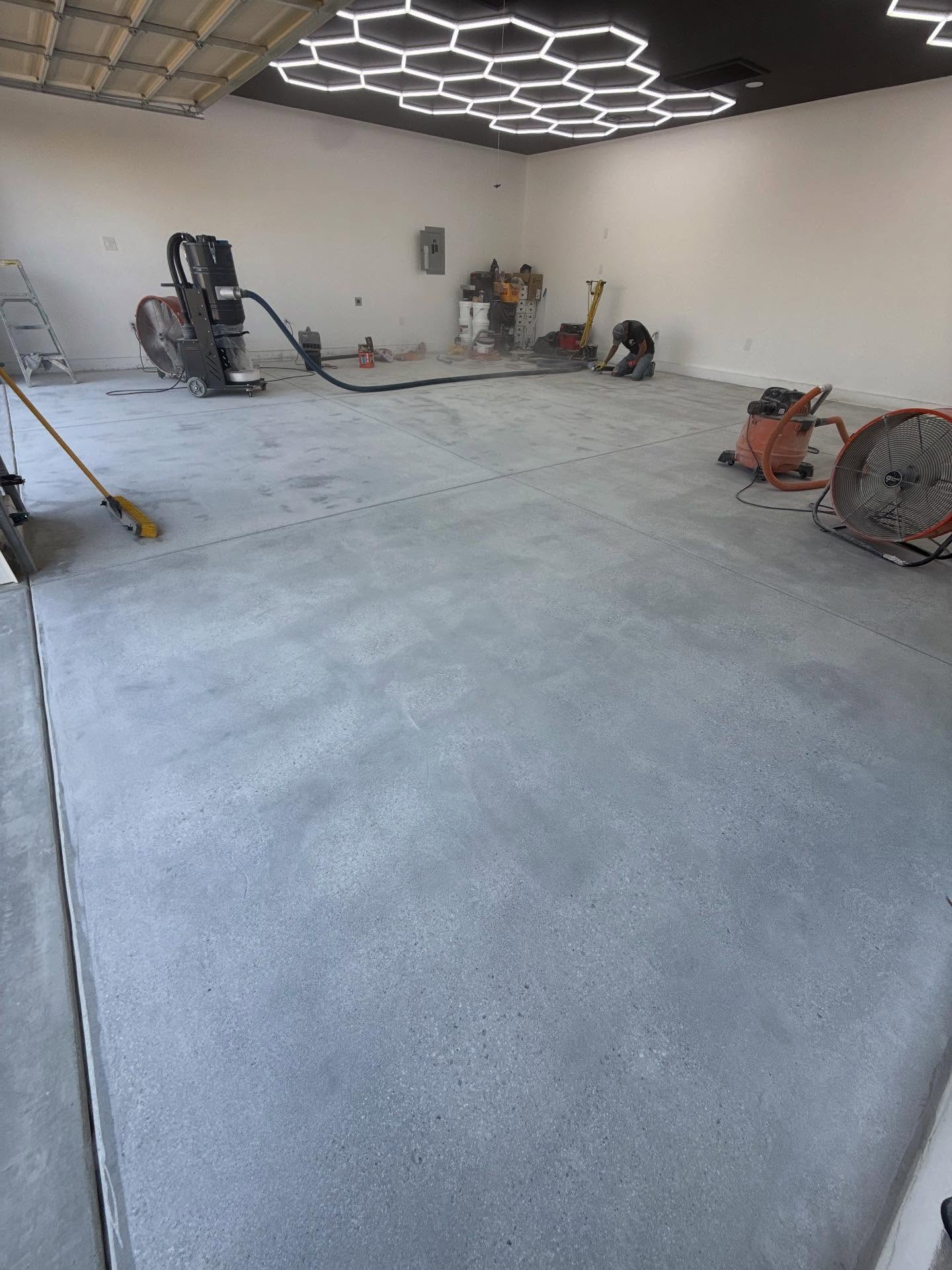
Flake epoxy in Santa Clarita.
The system we recommend most often here, and usually for practical reasons rather than looks. This valley is dusty and bright, and flake handles both.
Why flake suits this valley.

Santa Clarita throws a lot of grit around. Dry summers, wind through the canyons, and construction still going on at the edges of the valley mean dust gets tracked onto every floor here whether it is a garage or a patio. A solid color floor announces every bit of that. A broadcast chip pattern absorbs it visually, which is why a flake floor still looks right in year three when a plain one does not.
The other reason is grip. Anything that gets wet, a garage taking a car in during a winter storm, a covered patio, a pool surround, needs texture that is part of the surface rather than sprinkled on afterward. Flake builds that in by construction rather than as an additive.
And it repairs. Because the chip pattern is random rather than a one-off flow, a damaged area can be ground back, re-broadcast and topcoated, and the repair disappears into the surrounding pattern. That is the practical advantage over metallic and it is why we put flake into rooms that take real use.
Full refusal, and why it decides the quote.
What full refusal means
Chip broadcast until the surface physically will not take more and no base coat is visible anywhere. That is the specification worth asking about by name.
What a partial broadcast is
Chip scattered for appearance with base coat showing between the pieces. Looks fine on day one. The exposed base is the weak point and it wears through in the traffic lanes.
Why both quotes say flake
They will. The difference is chip weight per square foot and whether base coat shows. Ask that directly and the two numbers on your table start making sense.
Chip size changes the feel
Larger chip in a high-contrast blend hides more and feels coarser. Smaller chip reads closer to a solid color and is smoother underfoot. Garages usually want the larger end.
Where the sun comes into it.
Anything outdoors in this valley needs a UV-stable topcoat, and that is not an upsell. Santa Clarita gets genuine high-desert sun, and a standard clear coat ambers under it. On a light chip blend that color shift is obvious within a year and there is no fixing it short of recoating the whole floor.
Covered patios, pool surrounds and anything visible through a garage door with glass all fall into that category. Indoors and away from direct light it does not matter and we do not charge for what is not needed.
The build is grind, patch, prime, base coat, broadcast chip to refusal, scrape and vacuum the excess, then two clear topcoats. The scraping is the tedious part and it is where a rushed job shows itself, because chip left proud of the surface feels sharp underfoot and collects dirt.
One more valley-specific note: construction dust is still a live issue at the edges of Santa Clarita where tracts are going in, and grit tracked onto a fresh floor during cure is the most common avoidable problem we see. We mask the entry route and ask you to keep the space closed until the topcoat has hardened, which is usually the following morning.
Two to three working days for a residential floor, walk on it the next day, park after about seventy-two hours. We bring chip samples to the walkthrough, because a blend looks quite different across a whole floor than it does as a handful, and it is worth seeing against whatever the room sits next to.
Flake goes into most garages we do here and into commercial back-of-house rooms. Where a floor is a showpiece rather than a workhorse, metallic is the other direction. System specs live on the main flake epoxy page. Santa Clarita and Los Angeles County are both standard territory for us.
Flake questions we get every week.
How do I tell a full refusal quote from a cheaper one?
Ask how much chip goes down per square foot and whether base coat will be visible anywhere. A full refusal answer is a specific weight and a flat no. A partial broadcast quote usually talks about coverage or a percentage instead. Both quotes will still use the word flake, which is exactly why the question matters.
Is it rough on bare feet?
Depends on chip size and how heavily we topcoat. A garage can take a coarse texture. A patio people cross barefoot gets a smaller chip and an extra clear coat, which fills between the pieces and smooths the surface while keeping the grip. Tell us where the floor is and it gets specified accordingly.
Will the color fade outdoors?
Not with a UV-stable topcoat, which is what anything getting direct sun here gets as standard. With a normal clear coat it will amber, and on a light blend that shows within a year. Santa Clarita sun is stronger than coastal LA and it is worth being specific about which rooms are exposed.
Can it be repaired?
Yes, and it is the main practical advantage over a poured metallic floor. The chip pattern is random, so a damaged area gets ground back, re-broadcast and topcoated, and the repair disappears. There is no visible boundary the way there would be on a metallic re-pour.
How many colors can I have?
Chip comes in pre-blended packs and custom blends, so the range is wide. We bring samples to the walkthrough because a blend reads differently across a whole floor than in your hand. Worth thinking about what the room adjoins, particularly a garage that opens into finished living space.
Does it work on an uneven old slab?
Better than most systems. The chip breaks up the reflection so the eye stops reading small ripples, which a smooth gloss floor would highlight. It does not fix a slab that is genuinely sloped or broken, and that is a repair conversation before it is a coating one.
Santa Clarita, California. Patios in Saugus, garages in Valencia, back rooms along Soledad Canyon.
Flake epoxy for your Santa Clarita floor.
We bring the chip samples to the walkthrough and tell you which size and blend suits the room. The proposal that follows is fixed, not a starting point.
Chip blends are easier in person than on a screen. Book the walkthrough or browse the gallery first.