
Garage floors in Santa Clarita.
Bigger garages than the county average, newer slabs than most of LA, and summer heat that decides when we pour rather than the calendar.
Garage work across the valley.
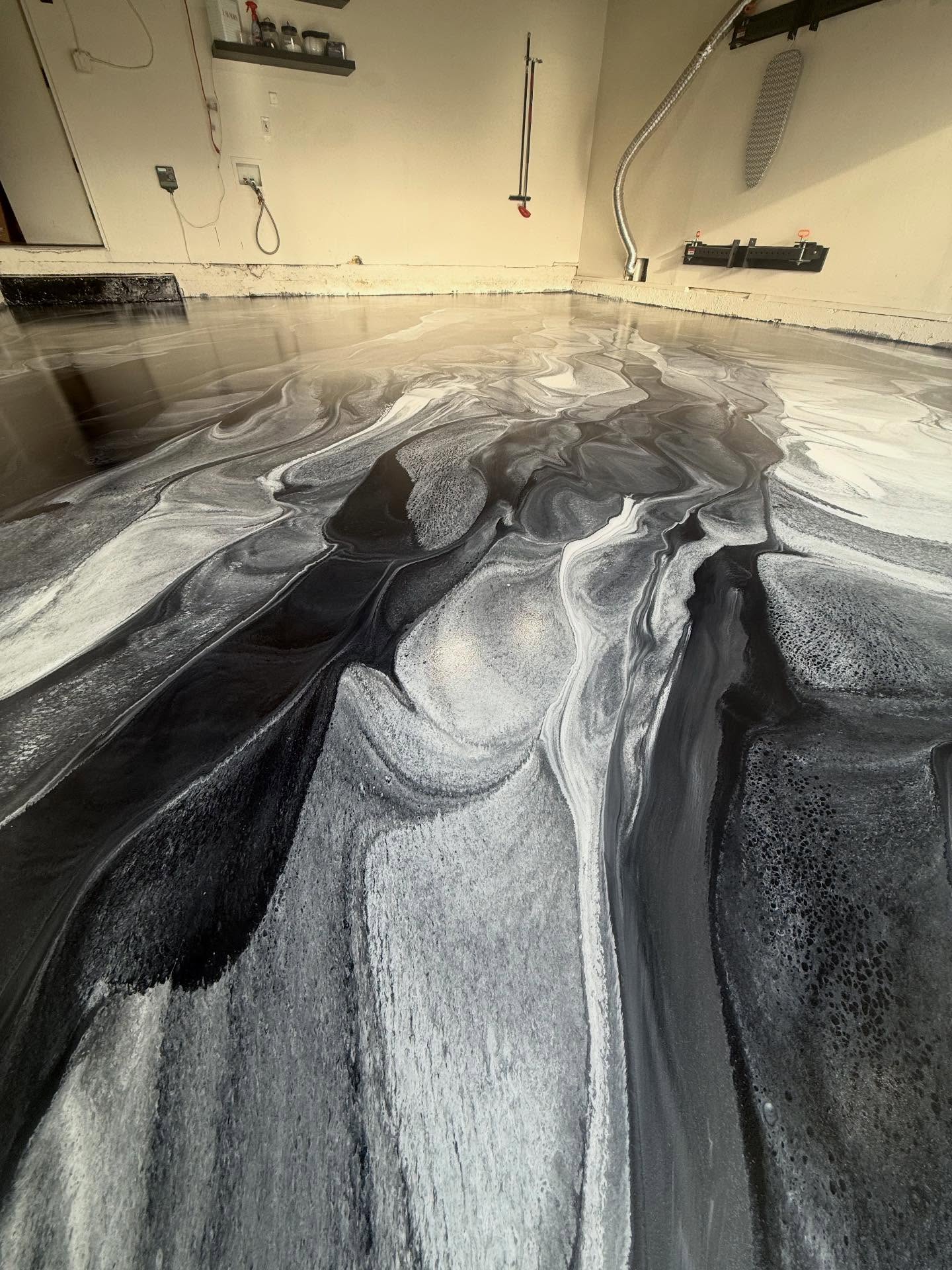
Santa Clarita garages skew newer and larger than most of what we coat in Los Angeles County, because the valley was master planned and most of the housing went up from the seventies onward. Three-car bays are common in Stevenson Ranch and the newer Valencia tracts, and a lot of them stopped being purely for cars a long time ago.
That changes what the floor has to survive. A garage doing duty as a home gym takes dropped weights. One serving as a workshop takes dragged toolboxes and the occasional solvent spill. A garage that is genuinely just parking takes hot tires and not much else. We ask what happens in the room before quoting, because those are three different specifications.
The older Newhall stock is where the interesting problems live. Those slabs have usually had something rolled onto them at some point, and it almost never comes up evenly, which tells you how well it was bonded. Grinding that off is most of the first day and it is the step a cheap quote skips.
What valley heat does to a garage pour.
Working time shrinks
A garage slab in this valley can sit well above ambient for weeks in summer, and resin cures on temperature rather than the clock. July pours start early or get cooling brought in.
Hot tire pickup
A tire off I-5 in August comes home far hotter than the concrete and lifts a weak coating away when the car moves. The topcoat is what resists that, so that is where the spend goes.
Fire-season storage
Households here keep generators, fuel cans and equipment in the garage through fire season. A floor that takes fuel and solvent without staining matters more here than in most of the county.
Winter moisture swing
Slab moisture climbs through a wet winter and drops hard by August. We read the slab rather than assuming, because the same garage gives different numbers in different seasons.
How a garage job actually runs.
The first day is grinding. Diamond tooling takes the surface down past oil, tire marks, old sealer and whatever previous kit is on there, leaving open concrete with a consistent profile for the primer to key into. Cracks and any spalled edges get rebuilt rigid while the slab is open, because anything left soft will telegraph through the finish and reopen.
Then primer, a broadcast coat, and topcoats. What goes into the middle depends on the answer about what happens in the room: a gym floor gets more build and a coarser texture, a parking-only bay can take a finer finish, a workshop gets the most chemically resistant topcoat we carry.
Timing is two to three working days for a standard bay from prep to final topcoat. You can walk on it the next day and park on it after about seventy-two hours. Summer heat shortens the pour window but not the cure, and a February install in this valley cures slower than a June one, so the schedule flexes with the season rather than pretending it does not.
Every job is a fixed-price proposal after an on-site walkthrough. We look at the slab, ask what the room does, and write a number that does not move afterward. If the floor needs repair before a coating is worth buying, that shows as its own line rather than being folded in quietly.
Garage work often runs alongside a flake system on a patio in the same visit, and homeowners who want the bay to be a showpiece usually end up looking at metallic. Everything about the system itself is on the main garage epoxy page. Santa Clarita is inside our standard radius, as is the rest of Los Angeles County.
Garage questions, answered.
How long is the garage out of use?
Two to three working days from prep to final topcoat, then about seventy-two hours before you park on it. Foot traffic is fine the day after the last coat. Cars are the constraint, because a hot tire on a floor that has not fully hardened is exactly how a new coating gets damaged in its first week.
My garage already has a coating that is peeling. Can you go over it?
No, and anyone who says yes is selling you the same failure again. Peeling means the bond underneath is gone, and it is gone across the floor even where it still looks attached. It comes off by grinding, we read the slab, then we start. That is more work up front and it is the difference between a floor that lasts and one that repeats.
Does the summer heat here cause problems?
It shortens working time during the pour rather than hurting the finished floor. A slab sitting at high temperature makes the resin gel faster than the datasheet suggests, so we start early in the day or bring temporary cooling into the bay. It is a scheduling problem, not a quality one, provided the crew plans for it.
Is flake worth it over a plain color?
In a garage, nearly always. The chip adds thickness, gives grip when a car comes in wet, and hides the tire marks and scuffs a solid color announces every day. It also means a repair blends into the pattern rather than showing as a patch. A solid color looks sharper for about six months and worse from then on.
Can you do it around everything we store in there?
The bay needs to be clear for the work. Most households move things into the driveway for the two days or stage it in half the garage if we are phasing a three-car bay. Tell us at the walkthrough what genuinely cannot move, like a fixed workbench or a water heater, and we cut in around it and mask the base.
What happens at the ten-year mark?
The topcoat is the wear layer, and on a heavy-use garage it can be refreshed somewhere around the eight-to-twelve-year mark without touching the system underneath. That is a scuff-sand and one coat, usually a single day. The resin layer itself is bonded to the slab and does not need redoing.
Santa Clarita, California. Garages from Stevenson Ranch to Canyon Country.
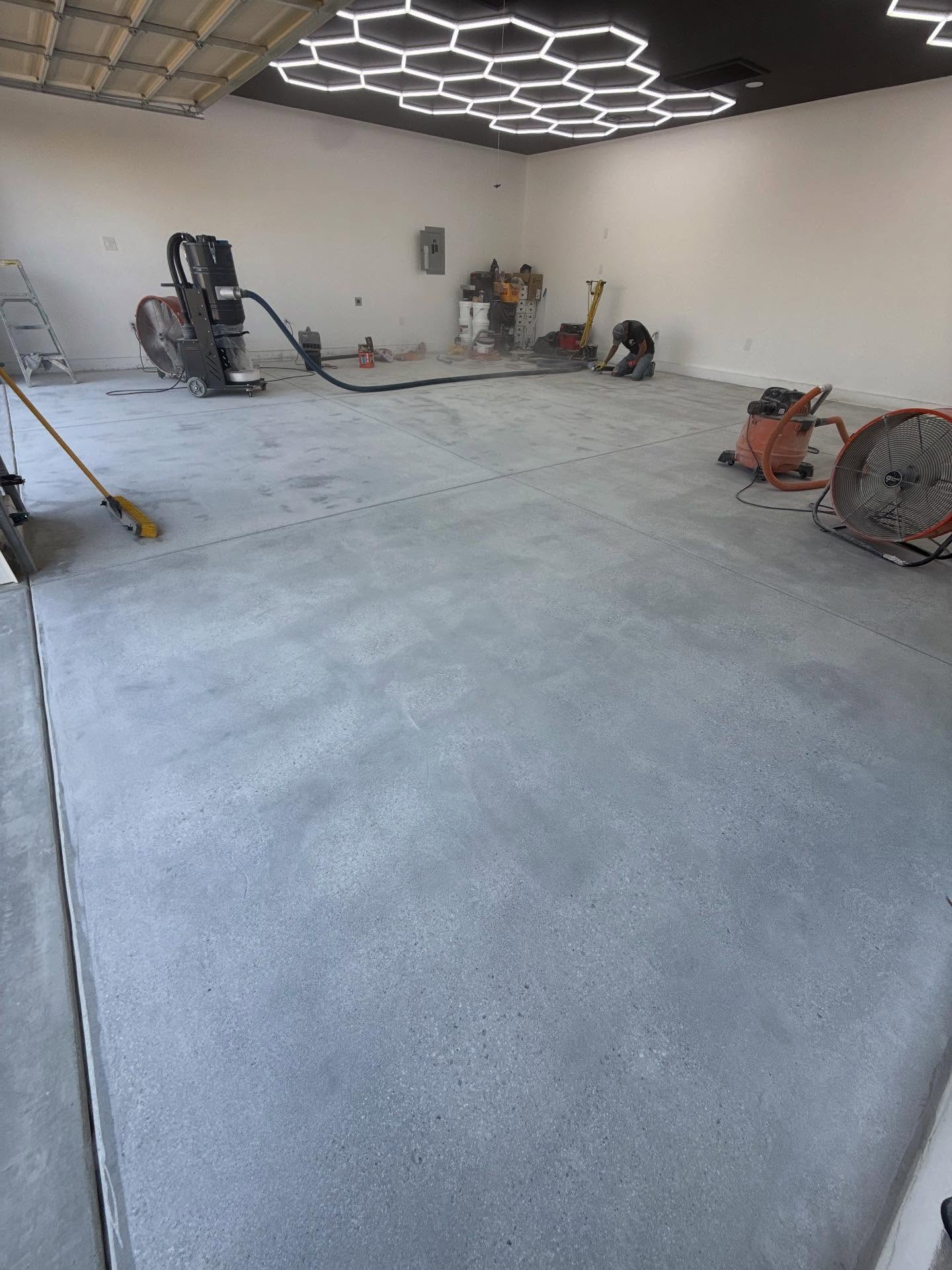
Garage epoxy for your Santa Clarita bay.
Tell us the size of the bay and what actually happens in it. We walk it, we price it fixed, and the number does not move once the slab is open.
Look through finished garages or tell us about the bay.