
Pasadena service
Polyaspartic floors that give Pasadena its garage back.
Polyaspartic and polyurea are the fast half of the resin world. Coats go down in the morning, the floor takes foot traffic that evening, and the car comes back in the next day. For a Pasadena household running a business off the property or working out of a converted garage, that one day is usually the whole decision. We coat floors across Bungalow Heaven, Linda Vista, the Arroyo, Hastings Ranch and the foothill streets under the San Gabriels.
One day off the slab, then back to work.
Polyaspartic cures on a clock measured in minutes rather than hours. That single chemical fact drives everything else about the system: the schedule, the crew size, the hour work starts, and the kind of installer who should be holding the squeegee.
What the fast return actually buys you
Here is a normal sequence on a two-car Pasadena garage. We grind the slab and chase out the cracks first thing, fill them with a polyurea joint filler that takes tool in about twenty minutes, run the base coat before the heat arrives, broadcast flake if the floor calls for it, scrape and vacuum, then lay the clear polyaspartic top in the afternoon. You walk on it that evening. Rubber tires go back down after roughly twenty-four hours instead of the five to seven days a full epoxy build wants before it will take a hot tire without printing.
Who that timeline is really for
Plenty of homeowners can live without a garage for a week. A lot of Pasadena households cannot. The block off Lake Avenue where somebody runs a cabinet shop out of the rear structure. The Craftsman on a narrow street in Bungalow Heaven with nowhere to leave two cars overnight. The couple who both work from home and need the driveway clear for a client at nine in the morning. Those are the floors where polyaspartic earns what it costs over a slower resin. If your garage is storage and you are in no hurry, we will say so, and point you at a standard garage epoxy build instead.
Color, cure and the weather window.
Three things separate a polyaspartic floor that still looks right in year eight from one that goes cloudy and streaky by the second summer.
UV stability where the sun actually lands
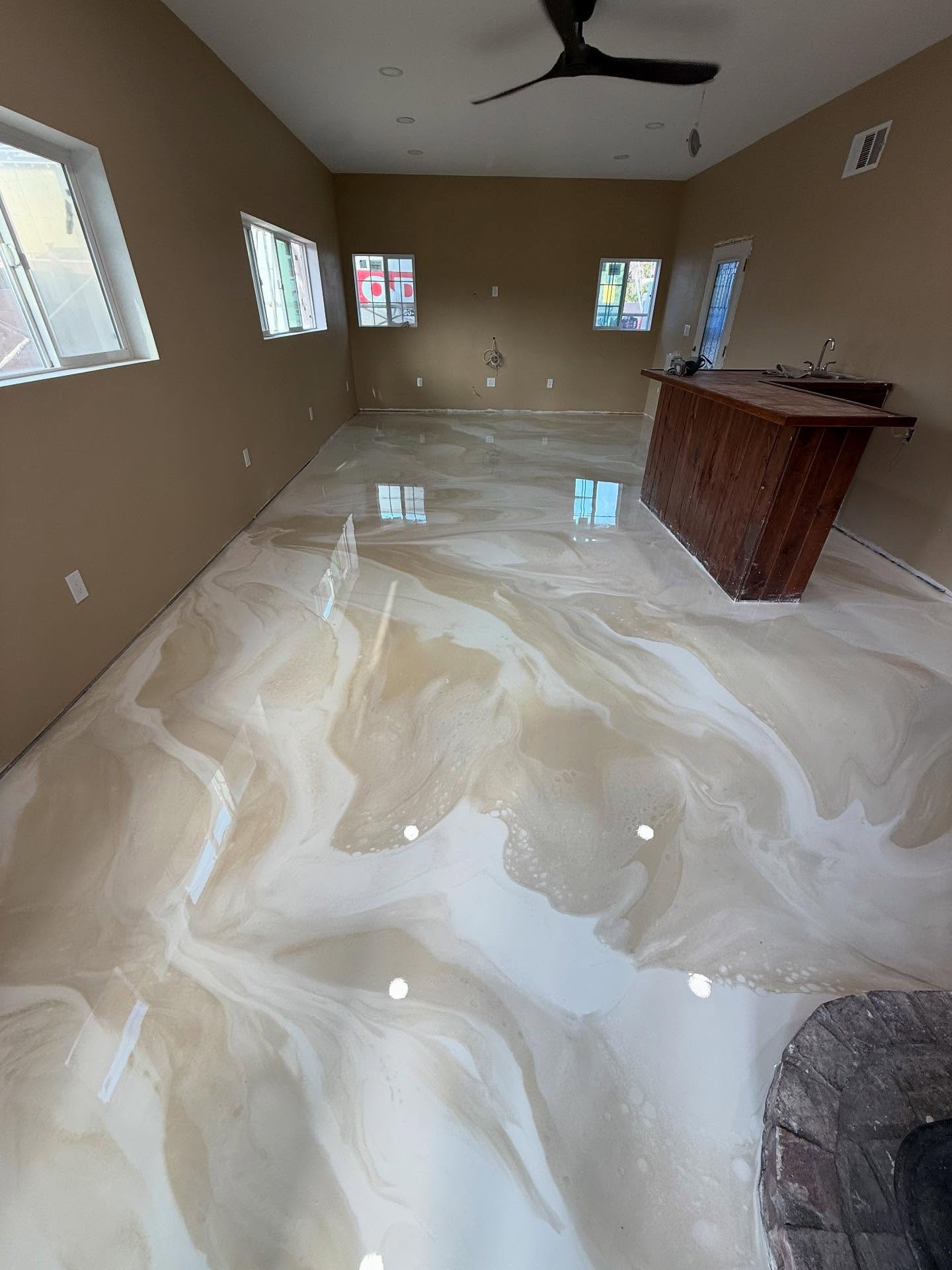
An aliphatic polyaspartic clear does not amber. That matters less in a closed garage than the marketing suggests and much more on the floors people forget about: a covered patio behind a Spanish Colonial Revival, a carport on a Linda Vista hillside, a west-facing garage whose door stays rolled up from noon until dinner. Pasadena gets hard afternoon light most of the year, and a straight epoxy clear under that light shifts warm within a couple of seasons. The polyaspartic top holds the color you chose.

The window on an inland summer day
Pasadena summers sit inland and dry, which is good for resin, and hot, which shortens working time. Once the slab is warm the pot life on a polyaspartic drops fast and the crew loses the ability to hold a wet edge across a wide bay. So we start early. Trucks on site not long after sunrise, grinding done while the concrete is still cool, coats down through the good part of the morning. If a heat wave lands mid-week we would rather move you a day than fight the material and leave you a floor with lap lines in it.
One crew, both trades
Concrete 2 Coatings has been under this name five years, with twenty years of trade work behind it and union training in the background. We run decorative concrete and resinous systems in house, so nobody subcontracts the grinding to a stranger and hopes the profile comes back right. On a fast-cure product that continuity is most of the job. The same people who opened the slab are the ones who close it.
Older Pasadena slabs come with conditions.
Moisture comes first, whatever the topcoat is
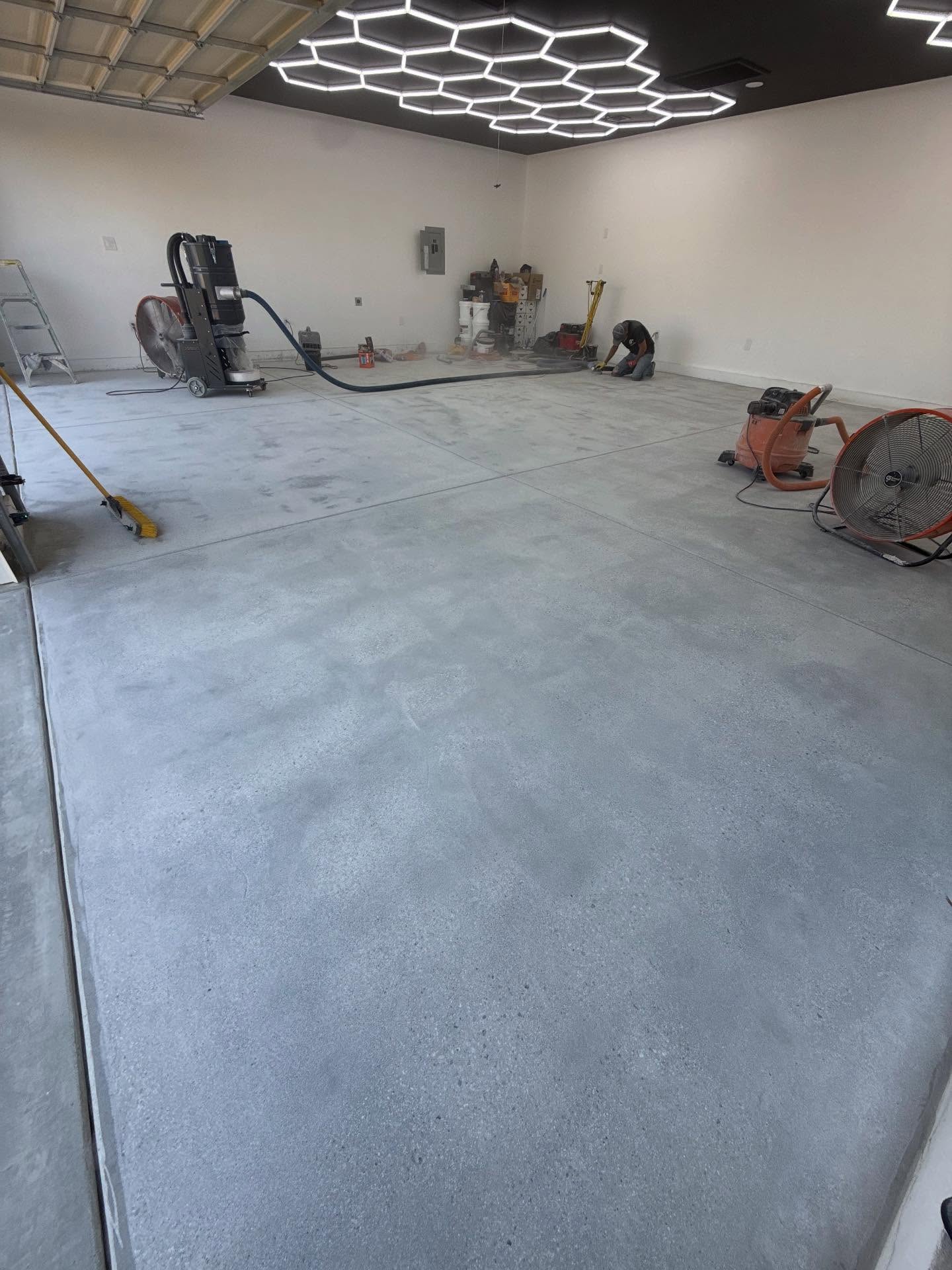
Most detached garages here predate vapor barriers entirely. A slab poured in 1928 or 1949 went down on graded dirt and it has been wicking ground moisture ever since. Fast-cure chemistry does not change that. We read relative humidity in the slab before we spec a system, and on a foothill lot that takes real winter runoff off the San Gabriels the number often decides the whole build. If it comes back high we put a moisture-tolerant primer under the color coats. Skipping that step is exactly how a beautiful floor lifts in sheets two winters later, and it is the most common reason we get called to redo somebody else’s work.
When a hybrid build beats a full polyaspartic system
Full polyaspartic is the right answer when the schedule is the constraint or when the floor lives in sunlight. It is not automatically the better floor. On a rough, patched, hand-floated slab with an uneven surface, an epoxy base coat has more body, wets out the concrete more forgivingly, and fills small imperfections that a thin fast coat will telegraph straight through. So on a lot of Pasadena garages we build hybrid: epoxy base for adhesion and body, polyaspartic clear on top for the UV stability and the quick return. You still get the car back the next day. Ask at the walkthrough and we will show you both systems on the same slab.
Fast chemistry is a workmanship risk
Worth saying plainly, since most companies selling one-day floors will not. Polyaspartic gives the installer minutes of working time per section, not hours. There is no going back to feather an edge, no second pass at a low spot, no pause to answer the phone. A crew that has not run the material in heat leaves roller lap lines, dry seams where two sections met late, and flake broadcast that thins out toward the wall. The product is unforgiving of a cheap install, which is the strongest argument there is for hiring on experience. Look through the finished work in our gallery, then start a walkthrough on the contact page.
Pasadena, California. Garages, patios and shop floors from the Arroyo across to Hastings Ranch and up into the foothills.
Other floors we build around Pasadena.
Polyaspartic is one of several ways to finish a floor here. If the calendar is not driving your decision, these are the other systems we install in town.
Resinous
Questions before the walkthrough.
Can we really park on it the next day?
Yes, on a standard polyaspartic build. Foot traffic the evening of the pour, vehicle tires after about twenty-four hours. Heat and humidity move that window a little in either direction, and we will give you the real number for your floor before we start rather than after.
Will a polyaspartic floor yellow the way an older epoxy did?
An aliphatic polyaspartic clear is UV stable, so it holds its color under direct sun. That is why we top nearly every exterior or sun-exposed floor with it. A straight epoxy clear left in Pasadena afternoon light will shift warm over time, which nobody notices in a closed garage and everybody notices on a covered patio.
Why does the crew show up at sunrise?
Working time on polyaspartic shrinks as the slab heats up. On an inland summer day the comfortable window is early. Starting at dawn lets us grind cool concrete, hold a wet edge across the whole bay, and finish coating before the afternoon. It is a material decision, not a scheduling preference.
Our garage slab went down in the 1930s. Is it too old to coat?
Age by itself is not the problem. Moisture and surface condition are. We test the slab for relative humidity and look at how it was floated, then match the primer to what we find. Thin hand-poured slabs with hairline cracking take a coating beautifully once the cracks are chased out and filled with polyurea.
Full polyaspartic, or an epoxy base with a polyaspartic top?
It depends on the slab. Full polyaspartic when speed is the priority and the concrete is sound. Hybrid when the surface is rough or heavily patched, since an epoxy base carries more body and hides imperfections a thin coat would show. Both come back to service in about a day.
What happens at the walkthrough?
About thirty minutes on site. We look at the slab, read moisture, check where water runs on the driveway side, talk through flake or solid color, and confirm what your week can actually give up. The fixed-price proposal lands in your inbox the next morning with the system written out line by line.
Book the walkthrough, keep your week.
Thirty minutes on your slab, a fixed-price proposal the next morning, and a straight answer about whether the fast system is worth it on your floor. Call (714) 702-2567.