A poured metallic floor is a chemical reaction you get one attempt at. Where afternoon sun comes through a window or a glass garage door, you also get a second question nobody asks until the color has already shifted: what the clear coat over the top is rated to survive.
Metallic is the system Santa Clarita requests by name more than any other, and the housing stock explains it. Large newer bays with good natural light are exactly where a poured metallic reads well. That same good natural light is what makes the topcoat specification matter here more than it does closer to the coast.
Direct sun and what ambering looks like
Standard epoxy ambers under ultraviolet light. It is not a defect and it is not a product failure. It is what that chemistry does when sunlight hits it for long enough, and this valley delivers genuine high-desert sun rather than the filtered version the coastal cities get.
On a dark metallic pour the shift is slow to notice. On a light one it is obvious inside a year, and it does not arrive evenly. It arrives exactly where the sun lands, which means a bright rectangle of shifted color across an otherwise correct floor, tracing the shape of the window that caused it.
There is no correcting that once it has happened. The metallic layer is buried under the clear coat, so fixing the color means taking the topcoat back and recoating the whole floor rather than the affected patch. The fix is a UV-stable polyurethane topcoat specified at the start, and any quote for a sunlit room that does not mention it has a real gap in it.
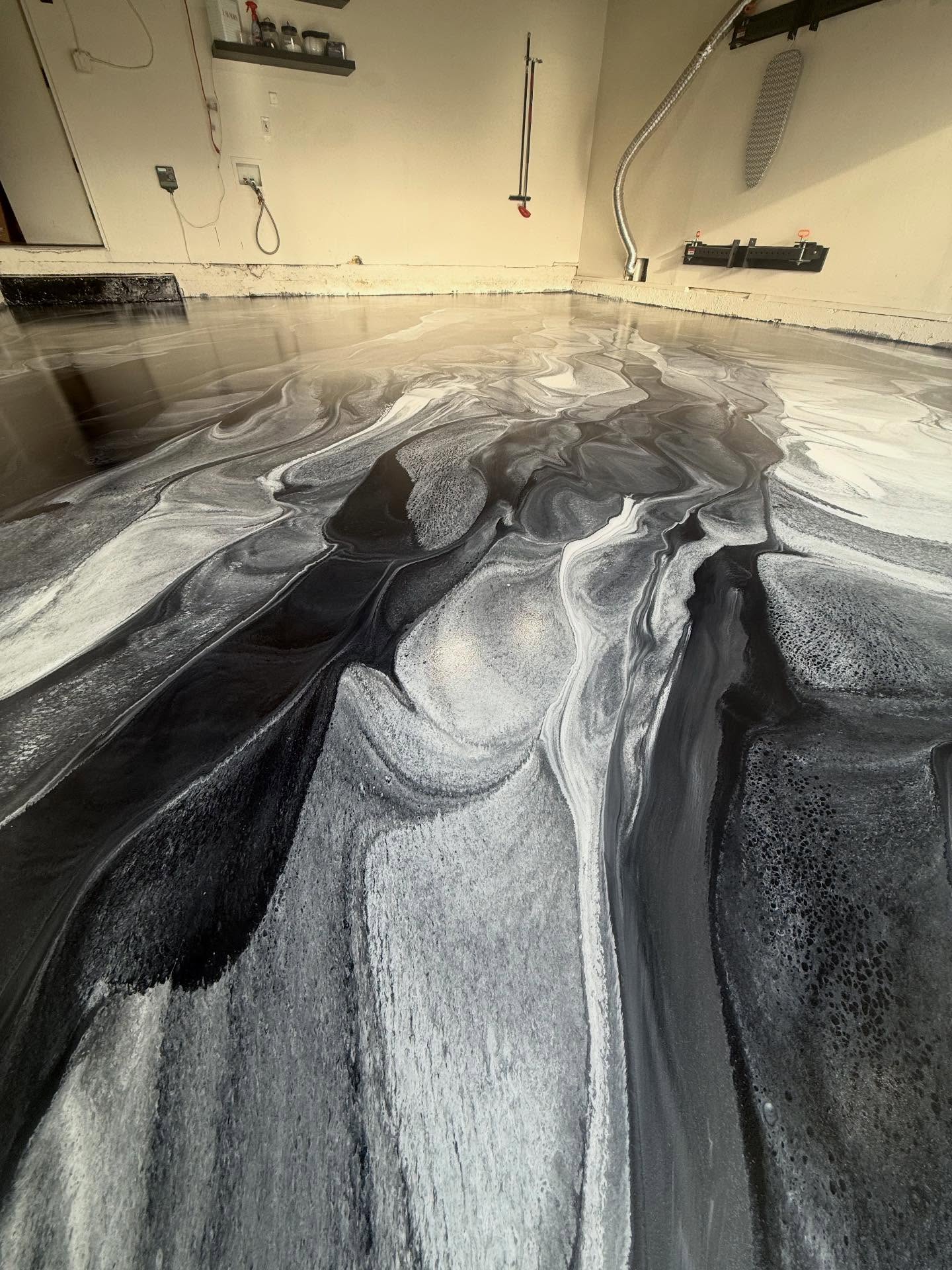
One shot, and the heat decides how long it lasts
Metallic pigment migrates while the resin moves and settles. The veining you end up with is a record of that movement, frozen at the moment the resin gels. That is the appeal of the system and it is also the risk, because there is no going back and adjusting it afterward.
How long the crew has to work the material is set by the temperature of the slab. An unconditioned Santa Clarita garage in July gives minutes rather than the window the datasheet promises. That is why we schedule these pours for early morning or bring cooling into the space before opening anything.
The pattern itself comes from how two people move the resin in the first fifteen minutes. That is technique rather than product, and it is one of the few parts of this trade where the crew genuinely decides the outcome. A crew arriving at noon in August and opening the kit anyway is how a metallic floor goes wrong.
Flatness, because gloss reports everything
Metallic is self-leveling and thin, and the finish is glossy. Those two facts together mean the floor tells the truth about whatever is underneath it. Every trowel mark, every low spot, every ridge of old adhesive telegraphs through and then gets highlighted by the reflection.
Grinding is therefore most of the job on a metallic pour rather than a preliminary step. We take the slab down to one consistent plane and one consistent profile, and on a room that has had tile or another coating on it, that is the majority of the labor on the proposal.
What grinding will not do is flatten a slab with a real dip in it. Coatings are millimeters thick and they follow the substrate they sit on. Correcting genuine unevenness needs a self-leveling underlayment, which is its own scope with its own cost, and we would rather show you that number at the walkthrough than pour a gloss floor over a wave and let the reflection point at it forever.
The trade-off worth hearing before you buy
Metallic cannot be spot-repaired. A gouge cannot be blended in, because the surrounding pattern is unrepeatable by anyone, including the person who poured it. The options are re-pouring that section and living with a visible boundary, or re-pouring the room.
That makes the room selection matter. For a showpiece bay in Valencia or Stevenson Ranch, a lobby, or an interior where damage is unlikely, it is the right system and nothing else looks like it. For a workshop floor that takes dropped tools, or a commercial back-of-house area, we will point you at flake instead, which repairs almost invisibly because its pattern is random.
We would rather say that at the walkthrough than sell the more expensive system to a room that will chew it up. System detail and timelines are on the metallic epoxy in Santa Clarita page.

What the topcoat is really doing
The metallic layer is the picture. The topcoats over it are the floor. Everything you physically interact with, the gloss level, the scratch resistance, the slip behavior and the UV performance, is decided in those clear coats rather than in the pigment underneath.
That is why the topcoat conversation is where we spend time. A gloss metallic with no additive is genuinely slick when wet, so a garage where a car comes in during a winter storm gets a fine texture worked into the clear coat. It costs a little clarity in the reflection and it makes the floor safe to walk on. In a dry showroom or an interior we usually leave it smooth.
Build sequence is grind, patch, prime, pour, then two clear topcoats, and the schedule runs three to four working days for a normal room with cure time between coats. Light foot traffic is usually fine the day after the final coat, with vehicles after about a week in a garage. Dry air here helps those numbers land close to the datasheet.
Questions about sun, pattern and durability
Can you match a floor I saw online?
We can match the palette and the general character. We cannot match the pattern, and neither can the crew that poured the original. The veining comes from how the resin moves in the first fifteen minutes, so it is genuinely unrepeatable. Anyone promising an exact match is either misunderstanding the product or telling you what you want to hear.
Our garage door has glass panels. Does that count as sun exposure?
Yes, and it is the case people forget. Glass panels put a band of direct afternoon light onto the floor for hours, which is enough to amber a standard clear coat within a year on a light pour. Any room with real daylight reaching the floor gets a UV-stable topcoat from us as standard rather than as an upgrade.
Can you pour metallic straight over our tile?
No. Tile has to come up or be ground back to a sound level substrate first. Any movement or hollow spot underneath telegraphs through a thin metallic layer within months, and it will crack along the grout lines. Removal means dust and disruption, and it is the honest route rather than pouring over a floor that is going to fail on a known schedule.
Call the shop at (714) 702-2567 or book a free walkthrough through the contact page. Poured floors are in the gallery, and the local detail is on metallic epoxy in Santa Clarita.