Almost every failed coating we get called out to look at in Pasadena and the foothill towns failed from underneath. The floor did not wear out. Water vapor moving up through an old slab pushed the resin off the concrete. On houses built before vapor barriers were standard practice, that pressure is the norm, and the only way to know what you have is to test the slab before anyone picks a system.
We have twenty years in the trade and five years running Concrete 2 Coatings as a family shop, and moisture is the one subject where we will slow a job down. The wrong system over an untested old slab looks perfect on handover day and comes apart the following winter.
Water moves up through a slab whether anyone planned for it or not
Concrete reads as solid. It behaves more like a hard sponge, full of pores too fine to see. Ground moisture under the slab evaporates into those pores and travels toward the drier side, which in a garage is the surface you park on. Under a bare floor nobody notices, because the vapor reaches open air and leaves. Put a film over it and the vapor has nowhere to go. It collects at the bond line between resin and concrete, and it pushes.
On a slab poured over sheeting with a properly drained base, the volume arriving at the surface is small enough that a correctly chosen system lives with it indefinitely. On a Pasadena bungalow garage from the 1940s, or a foothill ranch house slab added in the early 1960s, there is usually no sheeting at all. There may be sand. There may be native soil. There may be concrete poured straight onto decomposed granite that drains beautifully in August and runs like a creek bed in February.
Housing stock age matters more here than in most of the county. Poly under residential slabs did not become routine until long after Pasadena, Altadena, Sierra Madre, La Cañada and the older blocks of Monrovia and Arcadia were built out.
What a moisture failure looks like
Bubbling and blistering. Raised domes, anywhere from a pencil eraser to a coaster in size, scattered across the floor or clustered in one corner. Press one and it gives. Cut one open and the concrete underneath is usually damp and clean, with no adhesive left on the back of the blister.
Delamination in sheets. The uglier version. The coating releases across a wide area and peels up in pieces the size of a floor mat, often lifting in one motion from a saw cut. The underside is smooth and the concrete face is bare. Nothing was holding.
A milky haze under a clear topcoat. Common on metallic and on clear-sealed polished work. The floor loses its depth and goes cloudy in patches that follow the wet parts of the slab. Moisture sitting in or under the clear layer is scattering light. It does not buff out.
Edge lifting. Along perimeter walls, around the apron at the garage door, and on both sides of an old crack. Those are the paths where the most vapor arrives, so they let go first while the middle of the floor still looks fine.
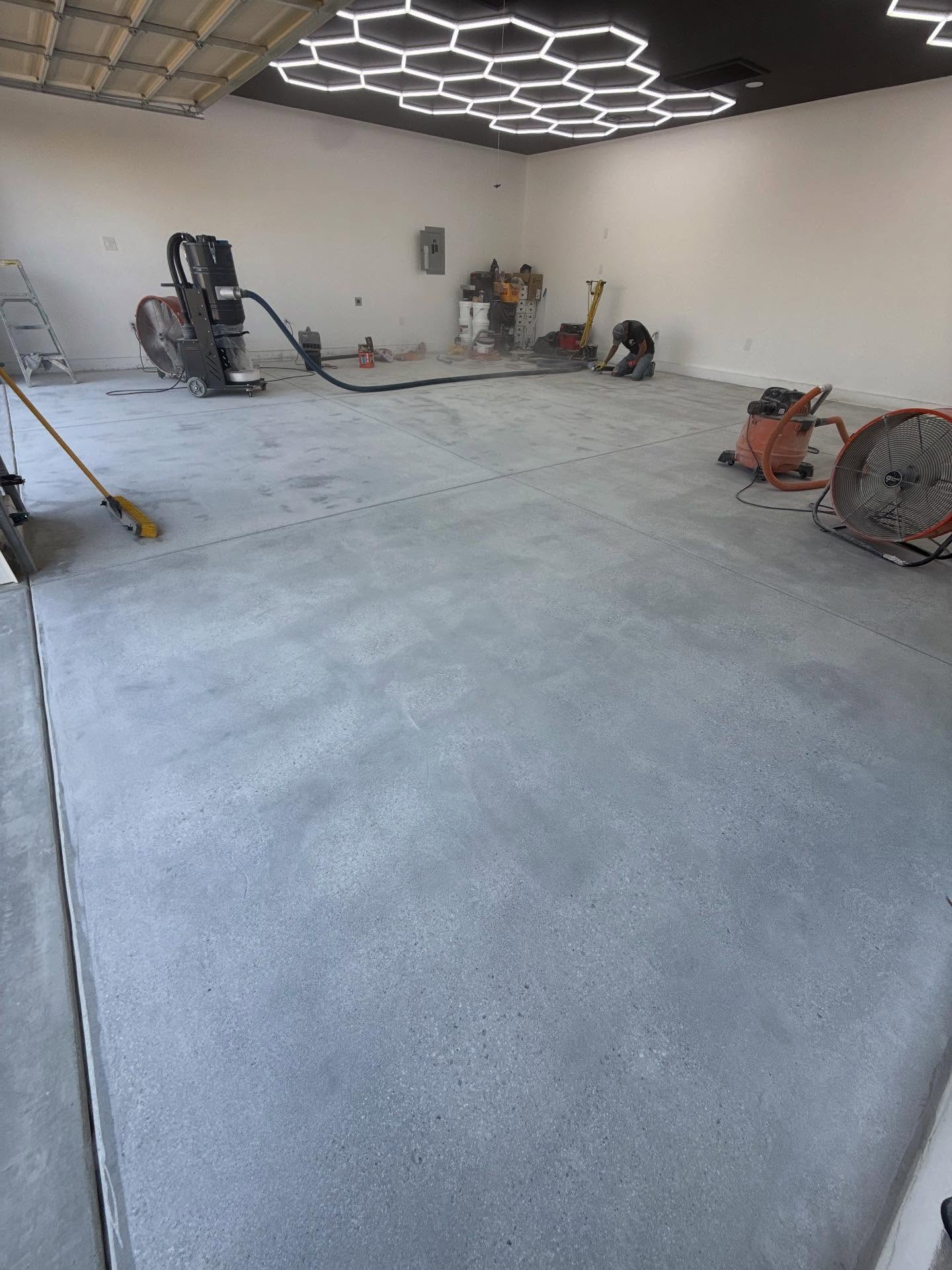
Why the blame usually lands in the wrong place
Moisture failures are slow and seasonal. A garage coated in July over a slab that is bone dry after four rainless months can sit perfect through the fall. Then the first real storm comes off the San Gabriels, the soil under the slab loads up, and by February the floor is blistering along one wall.
Seven months have passed by then, so the homeowner reaches for a recent cause: a hot tire, a jack stand, a jug of solvent that tipped over. The real cause was locked in before the first bag of grinding dust hit the vacuum, when nobody tested the slab.
The two tests that tell you something real
Two measurements are worth taking on an old slab, and they answer different questions.
A relative humidity probe inside the slab. We drill to a set depth, drop in a sealed sleeve, cap it, and leave it long enough for the air inside to come into balance with the concrete around it. Then we read the humidity of that trapped air. Because it reads from inside rather than off the top, it tells you what the concrete will do once you seal the surface and stop letting it breathe. On old slabs with nothing under them, this is the reading we trust most, and it decides which system the floor can carry.
A surface calcium chloride test. A small dish of dry salt sits under a sealed dome taped to the floor. The salt pulls in whatever leaves the surface over a set period, and the weight it gains tells you how much came out. That is a snapshot of what the top of the slab is giving off in the conditions in that garage on that day. Easy to run in several spots at once, honest about the surface, and blind to what the deeper concrete is holding in reserve.
Run together they give a fair picture: how much is coming out today, and how much is waiting behind it.
The plastic sheet trick is a screen, not a test. Tape a square of clear plastic tight to the floor, leave it overnight, look for condensation or a dark patch under it. If it comes up wet you have learned something useful for free. If it comes up dry you have learned almost nothing, because the weather that week and the spot you happened to pick both move the result. We use it as a first look on a walkthrough. We never let it choose a system.

Where the water is coming from on a foothill lot
Homeowners rarely connect the garage floor to the yard, and on these lots the yard is the story. Properties backing onto the foothills sit on ground that sheds real volume in a wet winter, and that runoff travels under structures rather than politely around them. A deep lot sloping toward the house feeds the slab every storm.
Then there is everything we add on purpose. Irrigation running against a garage wall three mornings a week. A downspout dumping at the corner of the apron with no extension on it. Mature landscaping planted tight to the foundation on a schedule set decades ago. A driveway resurfaced at some point and now sitting a little high, so it sheets toward the door instead of away from it.
Some of that is cheap to correct and worth correcting before we coat. Moving a downspout, capping two heads, pulling a planter back a foot: none of it is our trade, all of it lowers what the slab has to move. We point it out on the walkthrough because a drier slab makes a better floor.
What a mitigation primer can carry, and what it cannot
When a reading comes back high, the answer is a moisture mitigation primer: a dedicated coat that goes down first, built to hold back vapor pressure a standard primer would not survive. It is a real product class with real limits, and both halves matter.
What it does: takes the pressure the slab is generating and keeps it off the bond line of the decorative system above, so the flake, metallic or quartz floor you actually wanted can go over ground that would otherwise reject it. Applied correctly on a properly profiled slab, it becomes a permanent part of the floor.
What it cannot do: exceed what it is rated to hold. Every mitigation primer has a ceiling, and a slab reading past that ceiling needs the source addressed first, whether that is drainage, irrigation or grading. It also cannot fix a slab it never bonded to, since mitigation depends on aggressive mechanical profiling and is only as good as the grinding under it. And it saves nothing on a job where the readings were never taken, because nobody knew to specify it.
A high reading changes the build, and we would rather say so during the walkthrough than after. Whatever we find goes into the fixed-price proposal in writing, primer included.

An installer who skips testing on an old slab is selling you a callback
If someone walks a pre-1970 Pasadena garage, never drills a hole, never tapes a dome down, and hands you a number the same afternoon, they have guessed at the most likely reason your floor will fail. On a newer slab that guess is usually right. On these slabs it is a coin flip, and the coin lands in February.
The stakes climb on commercial work, where a failure takes a tenant’s floor out of service for days. We run decorative concrete and resinous systems in house with a union-trained crew, so the testing, the grinding, the mitigation and the finish coat are the same set of hands. Nobody is pointing at a subcontractor.
Ready to have the slab looked at properly? Start with garage epoxy in Pasadena , see the commercial epoxy work we do in Pasadena , read what we cover across Pasadena , or reach us through the contact page . The shop line is (714) 702-2567 and recent installs are in the gallery .